

As we have highlighted throughout this project, the large-scale deployment of wind energy is essential to meet renewable energy production targets. This requires the development and refinement of models and tools to optimise the use of high-altitude and complex terrain sites for wind energy installations.
As part of AIRE, a new study from CENER examines how wind behaves in complex mountainous terrain, specifically at the Alaiz test site, using high-resolution Computational Fluid Dynamics (CFD). This work focuses on two key scenarios: natural wind flow analysis and the study of the wake effects generated by turbines (areas of slower wind behind each turbine).
Why it matters
Wind farms in hilly or mountainous areas are promising for tapping clean energy…but conventional models stumble when faced with rugged terrain. Wake interactions between turbines become even harder to predict. That’s where Computational Fluid Mechanic (CFD) shines: by simulating real-world conditions with high fidelity, it can offer more accurate insights to boost efficiency and planning.
What they did
The team used steady-state RANS CFD to model wind on a terrain grid of approximately 20 km², factoring in vegetation, neutral atmospheric stability, and the Coriolis force. They deployed a specialised turbulence model (k–ε–fP) ideal for predicting turbine wake behaviour.
To make sure their model was reliable, they compared its output against data from six nearby met masts. The results showed solid alignment and speed errors stayed below 0.8 m/s, and direction errors stayed under 12°.
Next, they added a virtual wind farm using the Actual Disk method to model the wind turbine effect adding NREL 5 MW turbines. By calibrating turbine thrust and power coefficients to match wind speed at hub height, they mapped how wakes progressed downstream. Impressively, some steep velocity deficits of up to ~30% occurred within 2.5 rotor diameters, but certain areas saw full recovery only after almost 10 km!
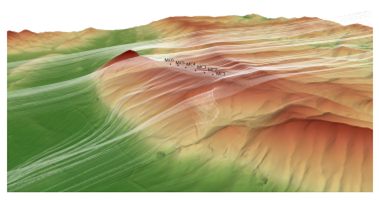
This figure illustrates how the wind navigates the complex terrain around the turbines. Notice how the streamlines bend and twist according to the topography, highlighting areas where wakes slow down the wind and where it recovers. It visually reinforces the study’s findings on wake dissipation and the influence of terrain on wind patterns.
They also noted a slight eastern deflection of wake flow, influenced by terrain depressions that steer westerly winds. Importantly, potential sites 10 diameters downstream could suffer wind loss of up to 1 m/s, reminding us how crucial layout choices are in complex landscapes.
Key takeaways
In brief this study analysed how wind turbines affect the wind in an experimental park in Alaiz. Using computer simulations, the researchers observed how the wind turbine wakes dissipated depending on the terrain. In some areas, the wind fully recovered at almost 10 km downstream.
They also found that the layout of the park can slightly reduce wind speed in nearby areas, by up to 1 m/s. The authors suggest that more detailed simulations should be used in the future to confirm these results and better understand how to optimise turbine placement.
For the full publication go to: CFD wind farm evaluation in complex terrain under free and wake induced flow conditions – IOPscience
Follow AIRE for more!
Author: Oria Pardo
Editor: Lucía Salinas
September, 2025

