

As we have covered in previous blogs, leading edge erosion of wind turbine blades is one of the main problems that reduces their service life and efficiency. Erosion is a function of the product of wind speed (which determines the impact of the raindrops) and rainfall intensity (which provides the erosive agent). However, many fatigue life models assume statistical independence between rain and wind, and this can cause underestimation of the hazards.
The aim of this study, carried out by our project partners from DTU, was to develop a probabilistic framework that explicitly models the wind-rain dependence based on copulas and applies it to the historical data in the UK and surrounding seas. This resulted in the creation of an erosion risk atlas, enabling rapid and site-specific analysis.
But what is a copula? A copula is a mathematical function that separates the marginal distribution of each variable (how they behave individually) from the dependence structure among them (how they interact with one another). This is particularly useful when variables don’t follow normal distributions or only have simple linear correlations. Copulas enable us to model nonlinear dependence and extreme co-occurrences, such as heavy rain and strong winds occurring together.
Methodology used
In this study, historical meteorological data for the British Isles and the surrounding seas was analysed. Estimating marginal distributions for wind speed and precipitation at each location and fitting copulas to understand the statistical dependence between the two. The generated atlas of probabilistic parameters can be utilized in reliability assessments and estimating the incubation period of erosion (time until blade damage becomes critical).
Study results
The results show a clear positive correlation between wind and rain when it was dry. The prevalence of this effect was particularly noticeable during heavy rain showers, when wind speeds (when it was raining) had intensity of 10 mm/h were around 50% (on average) faster than the average wind speed of measured days that did not rain. By omitting this dependence, we would overestimate the incubation period by up to 90% in regions with a strong correlation in airflow and precipitation (coastal, offshore areas).
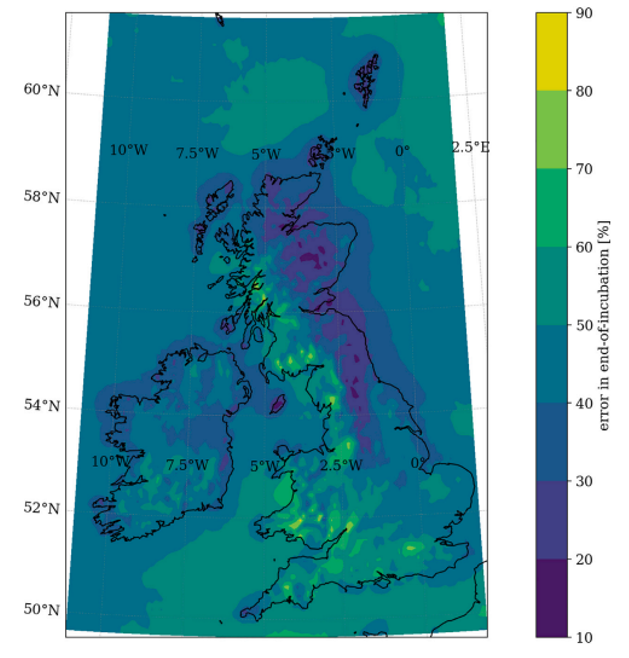
Map showing the ratio between end-of-incubation period estimated using copula and individual marginals
The previous image is one of the main results of the study. It shows the ratio of the end-of-incubation period, which is the point at which initial blade damage becomes critical, estimated using a copula (accounting for dependence) versus using individual marginals (assuming independence).
Therefore, the atlas allows for better estimates specific to local turbine operational environments, blade coating materials and operational policies that seek to balance blade life with energy losses. The study shows that copulas can be used as a better method to represent statistical dependence in erosion risk. The parameterized risk atlas informs machinery designers, operators and maintenance crews, as well as providing a faster method for assessing reliability and informing decisions about coatings and operational policies.
For the full publication go to: Copula-based joint distributions of rain and wind for leading edge erosion risk atlas – ScienceDirect
Follow AIRE for more!
Author: Oria Pardo
Editor: Charlotte Bay Hasager & Lucía Salinas
October, 2025

