

Continuing our series highlighting research related to the AIRE project presented at TORQUE 2026, this blog explores the paper “Modelling the aerodynamic losses from leading edge protection”. The study examines how protective shields affect airflow over wind turbine blades and how their design can help balance erosion protection with aerodynamic efficiency.
Leading edge protection helps shield wind turbine blades from erosion, but its installation can also affect aerodynamic performance. The small steps formed where protective shields end can disturb airflow, making their geometry and placement important considerations in blade design.
Why does protection design matter?
These steps can trigger an earlier transition from smooth, laminar airflow to turbulent flow, increasing aerodynamic drag. Their integration into the blade surface therefore matters alongside their protective function.
Understanding these effects helps designers assess how protection can be incorporated while limiting its impact on aerodynamic efficiency.
What did the researchers do?
The team compared two-dimensional computational fluid dynamics (CFD) simulations with measurements from DTU’s Poul la Cour wind tunnel using the NACA 63₃-418 aerofoil.
They investigated how shield coverage, step height and tapered edges, known as chamfers, influence the transition to turbulent flow and the resulting aerodynamic losses.
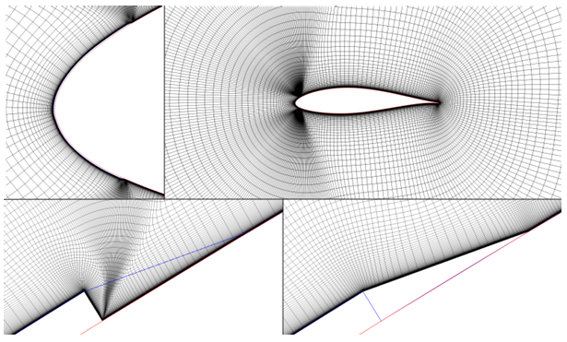
Figure 1. Computational mesh showing the aerofoil with leading edge protection and a chamfered edge. Source: Meyer Forsting et al. (2026), “Modelling the aerodynamic losses from leading edge protection”, Figure 2, Journal of Physics: Conference Series, 3224, 042064. CC BY 4.0.
Main findings
The aerodynamic losses were primarily associated with premature transition to turbulent flow. Within the investigated conditions:
- A step Reynolds number below approximately 900 indicated a region where steps did not trigger transition.
- Moving the shield’s end further downstream reduced aerodynamic losses.
- Chamfers helped mitigate the effects, but their effectiveness differed between the aerofoil’s two sides.
- A chamfer length of 20 times the step height made most tested steps subcritical on the pressure side, meaning they no longer triggered premature transition. However, this was insufficient on the suction side.
These findings show that protection geometry and local flow conditions must be considered together. A configuration that limits aerodynamic losses on one side of the aerofoil may not have the same effect on the other.
Why is this relevant to AIRE?
AIRE aims to improve wind turbine efficiency and durability by understanding how wind, rain and airborne particles affect performance. Its work combines experimental data, numerical models and prediction tools to support better blade designs and wind farm operation, while seeking to reduce energy losses and maintenance costs associated with erosion.
This study aligns with that ambition by examining the aerodynamic consequences of a measure intended to improve blade durability. It offers a useful perspective for AIRE’s work on design: protection and aerodynamic performance need to be assessed together when considering how blades will operate throughout their service life.
Towards better integration of blade protection
For designers, the practical implication is to include protection geometry in aerodynamic assessments from the outset. This can help connect decisions about durability with the wider objective of maintaining efficient wind energy production.
By identifying how the edges of protective shields affect airflow, the study provides guidance for integrating erosion protection with fewer aerodynamic penalties.
For the full publication go to: https://iopscience.iop.org/article/10.1088/1742-6596/3224/4/042064
Follow AIRE for more!
Author: Oria Pardo
Editor: Alexander Meyer Forsting & Lucía Salinas
October, 2026

